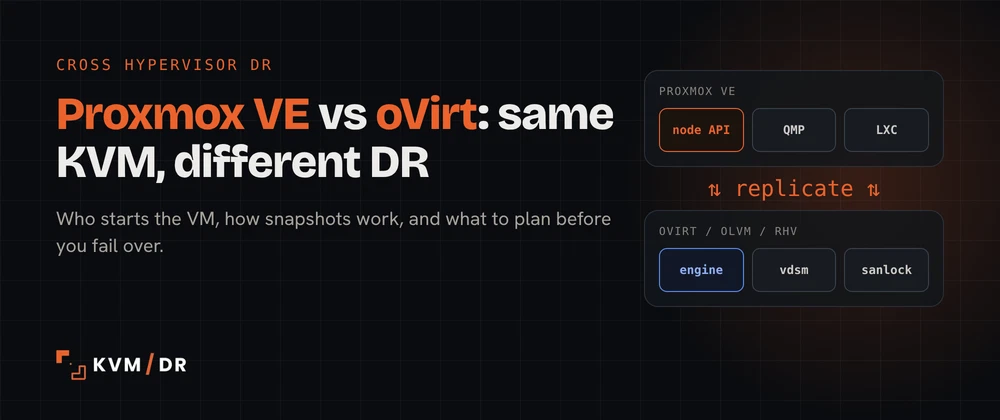
More teams are moving from oVirt or RHV to Proxmox VE, or running production on oVirt/OLVM with a Proxmox VE recovery site. Both run KVM/QEMU, so VMs move between them with their data intact. But the management model is completely different, and that changes what DR can do and what you must plan for.
1. Who starts the VM?
- Proxmox VE: every node has its own API and UI. There is no central manager; any node can create and start a VM on its own.
- oVirt / OLVM / RHV: a central engine owns every VM, disk and network in its database. A host's vdsm will not start a VM unless the engine tells it to.
So recovery on Proxmox depends only on the DR host. Recovery on oVirt also depends on the engine being up.
2. The stacks side by side
| Proxmox VE | oVirt / OLVM / RHV | |
|---|---|---|
| Management | Per node API and UI | Central engine |
| VM definition | Config file in /etc/pve/qemu-server |
Engine PostgreSQL |
| QEMU control | QMP socket directly, no libvirt | vdsm via libvirt |
| Locking | pmxcfs cluster lock | sanlock on shared storage |
| Containers | LXC | None |
| VM names | Valid hostname characters only (no underscores) | Underscores allowed |
3. Snapshots matter for DR
On Proxmox, LVM thin and ZFS snapshots are created almost instantly at the storage layer and behave as independent block devices: you can open one, boot it and throw it away without touching the original disk.
On oVirt, a snapshot stacks a new qcow2 layer on top of the existing volume, so the VM's write target itself changes. The chain belongs to one VM in the engine database, and the SPM host creates it.
4. When oVirt is the DR target
- No engine, no recovery. If the hosted engine is down, or ovirt-ha-broker isn't running, recovered VMs cannot be started.
- Disks must live in a storage domain. Pick the DR storage domain up front and size it for everything you protect.
- Testing needs extra space. A non disruptive DR test needs a test baseline on the oVirt side; on Proxmox it needs almost none.
- Map names and networks. Proxmox rejects underscores and uses Linux bridges such as
vmbr0; decide how oVirt logical networks and vNIC profiles map across.
5. What works in each direction
- VM replication, re IP and non disruptive testing work both ways.
- LXC containers cannot move to oVirt, so protect them Proxmox to Proxmox only.
- Failover to oVirt needs the engine running; failover to Proxmox needs only the DR host.
Takeaway
Same hypervisor, different control plane. Before you design cross platform DR, decide where the engine lives, how names and networks map, and how much test space each side needs.
The full write up, with diagrams and a best practice checklist, is a free PDF: https://kvmdr.ai/docs/KVMDR_Cross_Hypervisor_DR_Part1.pdf
About the author
- KVMDR builds near sync disaster recovery and continuous data protection for KVM: Proxmox VE, oVirt, OLVM and RHV. We write about changed block tracking, replication, failover and recovering from ransomware. Free homelab licence at kvmdr.ai/community.
Comments
Join the discussionNo comments yet. Be the first to comment.